
Table des matières
Culture malagasy
Unique culture
Madagascar’s cultural particularity basically lies on the fact that the country is a place where the Bantu people from Eastern Africa and South-East-Asia once met. The different physiognomies of the various tribes in Madagascar cannot be overlooked. Regarding the Betsileo and Merina tribes, the Indonesian impact is clearly visible in their almond shaped eyes, bright skin and straight hair. As for the other tribes, such as the Tsimihety, Sakalava and Bara, their Bantu origin is recognizable in their curly hair and black skin. The mix of African and Indonesian elements in the Malagasy culture is fascinating.
The pastoral or nomad culture, a distinct characteristic of the Bara, indicates their African origin. The cult of possession, or Tromba of the Sakalava also has an African origin. What’s more, a lot of agricultural products, such as sorghum, watermelons and onions originated in Africa. On the other hand, many elements such as the rectangular building structure, the rice terraces of the Merina and Betsileo, the forging technology with its air supply by two cylinders, the outriggers of the Vezo tribe, the excessive ancestor worship of almost every tribe and the grave sculptures of the Sakalava, Antandroy and Mahafaly originated in Indonesia. Despite the different ethnic groups in Madagascar, there is one single language on the island. The Malagasy language belongs to the Ma´anyan language family of Western Indonesia.
Tabou
Taboo
Fady is the Malagasy word for taboo. In the local language, the word Fady is both an adjective and a noun. The Fady is based on anecdotes and stories, and their roots are hidden in traditional legends and myths. For example, for the Mahafaly tribe living in the South of the island, it is Fady to eat the radiated tortoise. The history behind this Fady is that once, some people from that tribe cooked a tortoise. After a little while, someone looked into the pot, but found out that the heart of the animal was still beating. This made them horrified. This is an example of how a Fady starts. Fady goes hand in hand with the local religion. Pork is often Fady in sacred places. In several sacred sites of Antananarivo, onions and salt are Fady. In the village of Ambohimanga, the summer residence of the former Queens of Antananarivo, pork and chicken are Fady.
Circoncision
Circumcision
A ritual group circumcision festival
For “Antambahoaka tribe members”, manhood goes hand-in-hand with circumcision. The “Sambatra” festival takes place every seven years in Mananjary, in the south-east coast of Madagascar. It could last up to three months. As the tradition dictates, it must take place on Friday, a day that the community considers as a celebration day, and which follows a traditional farming calendar: the Friday year. The renovation of the royal hut marks the beginning of the ritual. Then the village’s fathers would decorate the ridge of a carved dove hut, symbolizing the ark of Noah. The mothers, for their part, would prepare the red outfits of the little boys and weave special mats for this occasion. Then young men would fetch water (in a sacred river) that would be used later to wash the wounds of the circumcised boys.
Posséssion
Spirit possession
Spirit possession ritual
Alongside the material beauty of the Big Island, Madagascar is also home to a plethora of ancestral practices among which the “Tromba” is worth a closer look. Typical of Sakalava tribe members, this spirit possession ritual usually takes place at rising full moon, during which the diviner, essentially a woman, invokes the spirits or “Tromba” of royal ancestors who once reigned in the southwestern part of the island. The ritual begins with a traditional polyharmonic song accompanied by hands clapping with accordionist providing it some rhythms. Venerated and honored, the invoked spirit manifests its presence by speaking through the mouth of its host, the possessed diviner. Family problem, theft, marriage, illness … the invoked ancestors would advise the living in whatever they are asked for. After all, the ultimate essence of Tromba is not just ritual but also curative. Some researchers take it as a movement of resistance to colonial religious practices.
Lever du drapeau
Raising flag
“Tsanga-tsaina” or “Tsanga-tsaigny” is a traditional festival held every five years in Ambatoharanana, the capital city of the ancient Antakarana kingdom (in the northern part of Madagascar). Actually, the Tsanga-tsaina festival is an occasion for the descendants of King Tsimiharo and the Zafimbolafotsy dynasty (all parts of the Antakarana tribe) to show up their unity and attachment to their customs. The ceremony is held as follows: Pilgrimage and royal baths in Nosy Mitsio: the present Antakarana king and his family head to Nosy Mitsio, in the sacred cave of Ankarana where King Tsimiharo hid during the Merina invasion. The making of the royal mast: a group of men is assigned to find two large straight trees in the forest, cut and bring them to the village. Then another group of men would craft the royal mast using the timbers. Once finished, it would be erected in front of the King’s premise.
Musique Malgache
Music of Madagascar
One music, multiples forms, distinctive genres
Like any other country where ritual ceremony once defined local manners, Madagascar’s traditional music heritage still remains intact despite the test of modernization. Currently, there are about twenty traditional and authentic music genres here in Madagascar. In the Northern part of the island, people dance to the rhythm of “Salegy”. It is even the most preferred music genre here-in, especially when it comes to celebratory events. In the great South, you will get embarked on a melancholic music universe worthy of a great Greek opera, but with an African twist, the “Beko”. Typical of the western part of the island, “Malesa” is characterized by soft and rhythmic tempo. ‘Grand Maître Tianjama’ was the first ambassador and promoter of this music genre. If the eastern part of the island is included in your travel itinerary, you will surely be listening to “Basesa” music. Like all the other types of music cited above, ‘Basesa’ originated from folk music. Fortunately enough, it has recently synced with modern instruments.
Cuisine Malgache
Malgasy Cuisine
A closer look on Malagasy cooking tradition
Alongside the opportunity to discover breathtaking landscapes, a stay in Madagascar is also synonymous of a culinary journey with diverse yet special dishes to delight one’s taste buds. As bizarre as it seems (for an island situated a few miles away from the continental Africa), rice is a major part of Malagasy cuisine. It is generally served with an accompaniment called “Laoka”. One of the most loved variations of ‘laoka’ is the “Ravitoto”, a traditional Malagasy dish consisting of mortar-pounded cassava leaves with greasy pork. The “Romazava”, for its part, is a broth made up of ginger, Anamalao’s flowers and Anatsonga. Served essentially in festive meals, Romazava is a side delicacy that is worth a taste.
In suburb marketplaces and on the roadside leading to Mahajanga and Antsiranana, you would surely encounter merchants selling smoked dried fish, exotic fruits, mango-lemon pickles, and peddlers with their « Koba », and so forth. And if you feel like tasting them, just don’t hesitate to buy. You will be satisfied. For foodies, especially those craving for European dishes, a special chef-cooked delicacy consisting of zebu meat is what we recommend you, the “green pepper-spiced steak”. Just try and delight your taste buds!
Population Malgasy
Malgasy Population
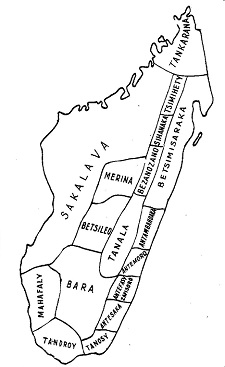
The origin of the Malagasy population
Madagascar is where Africa and Southeast Asia meet culturally. Although archaeological findings made in the Ampasindava Bay, in northwest of Madagascar, clearly indicated an African Bantu culture of the tenth century, Asian cultural influences in southeast Malagasy society cannot be denied. The almond-shaped eyes of the Merina people, of the tribe of Antananarivo, and the gable roofs of the traditional houses reveal their Southeast Asian or Nusantara origin. Rice terraces, outrigger canoes and the Monolith culture are other Southeast Asian cultural elements that were introduced in Madagascar by immigrants.
The obvious question is how and why Austronesians came to Madagascar. The trade route between the Red Sea and the Indian Ocean has been known since the third century. One could assume that the Austronesians of this time were trying to expand their trade routes. Among other things, they were looking for spices. Since these areas were known for their spices, they dropped their anchor in South India and later on the coast of Madagascar. However, some historians believe the arrival of the Austronesians may have been just a coincidence. Historical Arab sources tell of an attack by Indonesian outrigger canoes on the Southeast African coast in the 10th century.
A further thesis describes the arrival of the Austronesians with two stopovers. The first stopover was made in South India. Since the fourth century, there have been relations between South India and Western Indonesia. The Indonesian rulers of this period were inspired by the Hindu religion and Hindu teachers acted as consultants to Indonesian Kings. After reaching South India, half of the distance from Western Indonesia to Madagascar was already accomplished. The second stopover occurred on the East coast of Africa.
In his famous book « Histoire de la Grande Isle Madagascar » (1656), Etienne de Flacourt describes smaller communities, which likely populated Madagascar during the pre-Christian era. Jewish communities were mentioned, among others, as having arrived in Madagascar as early as the 8th century BC. They were Idumaean parishes coming from areas along the Red Sea. Sainte-Marie and Fénérive Est are said to belong to these old Jewish settlements in Madagascar.
Arab traders as well as the Kings of the Merina monarchy practiced slave trade. The Bantu men from the East coast of Africa were caught and shipped to Madagascar. The Malagasy monarchy abolished slave trade in the 19th century. Some of the prisoners remained on the West coast of Madagascar and started families with local women. During the reign of the Chinese emperor Tcheng Tsou, an expedition was organised to Madagascar between 1405 and 1433. Under the leadership of Tchen Ho, some of the ships from the expedition landed at the southern tip of Madagascar.
In the 16th century, European immigrants started to arrive in Madagascar. Over time, Portuguese, French and English mixed with the indigenous population. The majority of Europeans landed on the East Coast and the southern tip of Madagascar. As such, the present Malagasy population evolved from a mixture of various people and from this, a unique culture emerged. Despite the existence of the 18 indigenous tribes on the big island, there is an irrefutable unity in the Malagasy culture. Malagasy is their only language and ancestor worship is still practiced, with regional variations across the country.
Exhumation
The return of the ancestors
For the Malagasy, the notion of home is connected to the family grave or Fasandrazana. Home is where the family tomb lies. This home is often in the countryside, away from the big city. To be buried in the family tomb has great significance. There is no worse evil than to be banished from the family grave for Malagasy people. This can happen if a family member has violated the family rules. Exiled family members must forego the privilege of the ancestors – the privilege of being wrapped regularly with new silk shroud. Exhumation is a central point of the Malagasy « worldview ». The entire existence is based on the relationship with the ancestors. In every house there is the « Zorofirarazana » or the corner of the ancestors. The question of where one comes from always elicits the proud mention of the ancestral village, where the ancestral tomb is.
Ambohimanga
Ambohimanga
Located 15 km from the capital of Antananarivo, Ambohimanga or « Blue Hill », is the most sacred hill in Antananarivo. In 2001, the Palace of Ambohimanga was listed by UNESCO as a world heritage site. The Palace of Andrianampoinimerina meets three of the six criteria for appointment as a UNESCO world cultural heritage site. First, the entire palace complex is preserved in its original state and secondly the Palace represents a pivotal period in the history of the country. Andrianampoinimerina had a vision for Madagascar as a united kingdom which thus ushered in a crucial change in the political history of the country. The third criterion concerns the current role of the Palace in the cultural life of Madagascar. On certain days of astrological importance, such as Alakaosibe and Alahamadibe, ancestral worship rites are held in different places within the Palace.
The Merina, the people of Antananarivo, call their deceased Kings « Ny Masina » or “the Holy ones”. Among them, Andrianampoinimerina was the most significant one during the prosperous period of the Merina history, and today he is still regarded as the great and wise one. The “Ariary “, the current currency is a tribute to his reign and the ancient law of pre-colonial Malagasy is also credited to his works. Even at that time, Andrianampoinimerina was aware of the importance of protecting nature. For example, during his reign it was not allowed to cut down the forest. It was not allowed to pick a single leaf in the forest, as he viewed the forest as a sanctuary filled with countless medicinal herbs, which ensured the health of his people.
Anyone who wants to get to know the history of Antananarivo will find important key elements in Ambohimanga. Ambohimanga is still the most important spiritual site of the Merina. The Palace is the capital of Ancestral worship. During the colonial period, non-indigenous jacaranda trees were planted at his Palace next to the Holy Aviavy trees. The King could not even make his palace his final resting place. For « strategic » reasons, his bones were dug up and brought to Antananarivo by colonial Governor Gallieni – sacrilege! Andrianampoinimerina means: The King who remains in the heart of the Merina.